Aula ministrada na Loja
Teosófica Liberdade no Curso de Introdução ao Pensamento Teosófico versando
sobre os princípios da Astrologia Esotérica

quarta-feira, 24 de setembro de 2014

terça-feira, 23 de setembro de 2014
domingo, 14 de setembro de 2014
sexta-feira, 11 de abril de 2014
O Mundo que Sonhamos Viver
Palestra proferida em setembro de 2013 na loja liberdade com a leitura e comentários da Carta de Águas de São Pedro, produzida por ocasião do 7o Simpósio Regional do Saber Universal - Fundamentos para a sociedade do Futuro, com o título "O Mundo que Sonhamos Viver", realizado em 23 de setembro de 2012.
Carta de Águas de São Pedro
Fundamentos para a Sociedade do Futuro
O 7º Simpósio Regional do Saber Universal apresentou importantes questões relacionadas ao atual padrão equivocado de vida, onde se privilegia o consumo, a conquista, a competição, centrados no desejo de ter e estar.
Esta distorção da conduta humana tem levado à exaustão os recursos naturais do Planeta com a destruição do meio ambiente, o que coloca o nosso mundo sob real ameaça de grandes proporções.
A transformação é inevitável, sendo urgente que todos nós percebamos e compreendamos a necessidade de nos engajar no processo de mudança de valores e no resgate da importância do ser.
Nenhuma mudança externa ocorre se não for precedida de uma profunda mudança de nossas atitudes internas, sendo imperativo transformar o consumo desenfreado, em parcimonioso e auto-sustentado, a conquista individual, em coletiva e distributiva e a competição egoísta, em cooperação, respeitando-se, naturalmente, as diferenças, os valores e os anseios individuais.
Assim, após reflexão sobre os temas, manifestamos nossas convicções sobre os fundamentos necessários para a formação da Sociedade do Futuro, sendo estes princípios norteadores para o desenvolvimento da convivência solidária e fraternal entre todos os seres, sencientes ou não.
Compartilhamos a idéia de que o princípio do ser humano é divino e que a aparente e errônea noção da separatividade do ego é que impõe o seu distanciamento dos valores eternos. Na realidade o ser humano está esquecido de sua real origem, mas esta não está perdida, sendo ela que o mantém unido aos outros em fraternidade. A divindade é a imanência, estando presente em toda manifestação da vida.
Ao voltar sua vida ao Cristo Interno ou ao Princípio Búdico, pela compreensão da transitoriedade da personalidade do ego, por meio do processo de autoconhecimento e autodesenvolvimento, o ser humano estará desperto para a luz, sendo a Iluminação o destino de todos.
Entendemos que o destino da jornada é a plenitude do espírito. Embora o livre-arbítrio se constitua em escolhas da personalidade, úteis ao aprendizado do ser humano em seu caminho evolutivo, ele não tem a capacidade para anular sua trajetória, pois chegará o momento em que ele agirá conforme a sua consciência para o Superior, fazendo-o retornar ao curso natural do rio da vida que deságua no mar da unicidade.
A vida após a morte é a transitoriedade da alma entre encarnações, passando pelos estágios do astral, mental até o descanso no mundo céu, retornando em um novo ciclo de vida, até a libertação final, onde o ser humano se transforma na própria expressão da divindade.
Comungamos da compreensão de que os ciclos são necessários ao processo de evolução e que os diferentes estágios em que os seres humanos se encontram resultam nas diferenças e pelo exercício da aceitação é que nos tornamos compassivos.
Entendemos que o ser humano depende dos meios físicos que o Planeta oferece e que somente com esses elementos é possível assegurar a continuidade à expressão da evolução da vida.
Assumimos responsabilidades pela preservação ambiental e que, com a adoção da ética do amor, possamos legar o provimento das condições de vida para as gerações futuras.
A “educação da alma é a alma da educação”. Ainda que não sejamos “educadores formais”, devemos assumir o compromisso pela disseminação dos valores, tornando-nos agentes multiplicadores da busca da verdade.
Aceitamos que a adoção do vegetarianismo é importante fator para assegurar a sustentabilidade e recomendamos a prática do mesmo. Quando não for possível, pois alguns ainda dependem da carne em suas dietas, que se adote um processo de mudança gradual nos hábitos, reduzindo o consumo de carne pela abstenção ao menos um dia por semana. A prática do vegetarianismo está relacionada ao respeito da vida pelos irmãos “menores” que têm direito à vida e dependem de nossa proteção e amor.
Desta forma, declaramos a adoção destes princípios para nortear nossa conduta visando à construção do novo porvir.
“Sejamos a mudança que queremos ver no mundo”.
Águas de São Pedro, 23 de setembro de 2012
Assinado: Participantes do 7º Simpósio Regional do Saber Universal, realizado nos dias 22 e 23 de setembro de 2012 (equinócio da Primavera no Hemisfério Sul).
quarta-feira, 11 de dezembro de 2013
The Last Supper
“The Last Supper”
By Antonio Carlos Jorge
 The theme we will address has never attracted much attention as it does on the current days. The recent success editorial of the book"The Da Vinci Code" by Dan Brown, instigated the imaginary, through a narrative that involves all of these matters related to the life of Christ questioning and presenting conjectures and theories, some credible and many others, in my view, without a lot of reasons, such as the mention of the work of Leonardo Da Vinci, "the Last Supper".
Before we talk about the meaning of Leonardo's work, let's quickly address some aspects of his life to understand the context in which all his work developed.
Leonardo was born in April 1452 in Vinci, a village near by the Florence, son of Piero da Vinci, a notary, and a servant. Leonardo was an illegitimate child, having no rights to his father's estate. But his father, zealous, did not abandon him, having assumed his creation. We must remember that Leonardo was born in the middle ages.
The end of the middle ages is determined by the fall of Constantinople in May 1453. Of course the change from one period to another does not occur through a single event. This is a process of transition that involves multiple events.
With the end of the Middle Ages we have the Renaissance, with the resurgence of the appreciation of man as a factor of relevance in all contexts. Begins Humanism, a movement that revolutionized the thought, emerging new concepts and worldviews. This new concept is a precursor of specialization of knowledge, resulting later in the systematization of human knowledge, with scientism and segregation of knowledge that until then was unified.
Leonardo is more a medieval wise man than a person aligned with trends Renaissance because he was not restricted in specifics knowledge like other geniuses contemporaries geniuses. He had a broad knowledge. He was not only a painter. He was a sculptor, musician, architect, engineer, inventor, anatomist, and also an astrologer, although his biography does not to mention about the universe of hidden knowledge. In short he had a universal knowledge. In all areas he left the mark of his genius.
When he turned 14, his father had placed him as an apprentice in the arts studio of Verrocchio who was a great master of Florence. The art workshops held not only artistic works such as paintings and sculptures, but also construction of buildings, bridges and works of engineering, metallurgy, war machines, everything that required creativity of man to make some kind of artifact.
Leonardo soon excelled in all these arts, having participated in the production of a painting by Verrocchio, by order of Lorenzo Medici, ruler of Florence. He did paint an angel face on a canvas and the delicacy of the lines and the play of light, called the attention of the Medici family, who came to protect him. At this time, the success did not depend on talent, but especially the figure of a protector, a Maecenas.
The Italian peninsula, at that time, was a region of many disputes, without the identity of a country, which has consolidated only in the second half of the nineteenth century with Garibaldi. There were city-states, which they lived in strife. Wars were fought systematically, in order to solidify the power of the clergy. In this context, a war was deflagrated against Florence, promoted by the Vatican, for there were many interests of political composition, dominance, hegemony and economic supremacy.
Leonardo facing this situation, after serving the powerful others, as the Borgia, for example, just moving to Milan, had offered his services to the Duke Ludovico Sforza. Just to get an idea of the talents of Leonardo, he presents his resume as primarily military engineer, as he liked to be recognized, Architect, Builder Weapons, inventor, musician and at the end of the list of qualifications is painter and this is just his ability is that Duke engages him. Ludovico became the new protector of Leonardo.
Among the many works that Leonardo executed custom Ludovico is the "Last Supper." The work should decorate the refectory of the Convent of Santa Maria delle Grazie. The work began in 1495 and was completed in 1497. In reality it did not complete. By the way, no work of Leonardo, except St. John and baby Jesus was completed. Were several lawsuits filed against Leonardo because he did not fulfill contract. Leonardo spoke "creation is divine, execution is slavish!"

The Last Supper was painted on the walls of the hall and Leonardo developed a new technique. It is often said that it is a fresco, but in reality a fresco is a painting done on a layer of newly applied plaster still wet. This technique does not allow error and touches later. As Leonardo was primarily a perfectionist, he wanted a technique that could shorten the drying process of the ink
This does not mean he was not an expert, but he wanted the drying delay to execute the work with the greatest perfection imagined. So he developed certain dyes and pigments that have been shown ineffective in relation to conservation. The fresco has been constantly attacked by the action of fungi that decompose, requiring constant maintenance and restoration. Disrespect for art is not a fact that occurs only in our days. Note that, by the need to create a passage for a next room, was opened and then closed the door just about painting, destroying forever a part of the base. A similar fact occurred with the Mona Lisa, which is a painting done on wood panel, which had the sides sawn.
Let us now turn to analyze the picture presented. We see that the figure of Christ is placed exactly in the center and if we trace two perpendicular lines, projecting the vanishing point, we have this convergence point exactly on the right eye of Christ.

Thus we have the picture, with Christ at the center position and the apostles distributed on both sides. Around Christ is formed a circle passing through the arc of the door at the back, forming a triangle with the apex up ward and the other with the apex downwards. In the book "The Da Vinci Code", Dan Brown speaks of these symbols in a simplistic way, relating them to the masculine principles, personified by the figure of Christ, and the female, formed between him and John standing right beside him ?.
As John's features are feminine Dan Brown claims to be Mary Magdalene, who had been his wife and mother of his daughter Sara, giving rise to the dynasty of the Merovingian, the first kings francs (?). He argues that even Jesus to be a Rabbi, could not be single, and would necessarily have to be married. This is true among the Pharisees, but if we consider Jesus as Essene it would not be a fact, because the Essenes took vows of chastity and poverty of course he could not be married. (See studies on Essenes in the Dead Sea Scrolls).
But that does not interest to the narrative of Dan Brown, because it would invalidate the book. Dan Brown is a researcher and I believe he has hisknowledge, but I also believe that it is not interested because it contradicts with their commercial interest, because the truth does not sell. This symbolism is represented with two triangles with opposite vertices, is actually very deep, being present in different traditions such as Vedic and Hebrew, which presents two interlocking triangles, forming the six-pointed star.
The six-pointed star, although it is known as the Star of David or Seal of Solomon is present five thousand years ago in the Vedas This symbol contains hermetic principles, such as correspondence, the polarity, as well as the sex and this cannot be reduced simply to a phallic reference. We are not depreciating the work of Dan Brown and recognize who never spoke much about these matters. These works have never been as visited as it is today and this in itself already has its importance, but we have to put things in their right places.
We can relate the triangle with vertex upwards (upper triad=Spirit), containing the principles Will, Wisdom and Mind (Consciousness). The triangle with the apex downwards relates to the matter (unconsciousness). Thus when the two overlapping triangles results in the manifestation of life.
It is the projection of spirit into matter, as we can also see in the painting of Narcissus (below right), by Caravaggio, where he falls in love with his own image reflected in the mirror of water, going to deny its divine origin and losing in the webs of illusion of the world of things, which is transitory, local and temporal. The world of things is composed of the four elements (Fire, Air, Water and Earth).

The combination of the three higher attributes mathematically generates the four material elements.
Let's see. By combining the primary elements, i.e., "A", "B" and "C", produce the four elements, where "A" is associated with "B", "A" is associated with "C", "B "associates with" C "," A "is associated with" B "and" C ".
Thus we have four secondary elements. We also make an analogy with the primary colors, which are blue, yellow and red, that combined together form the four secondary colors, constituting the structure of the septenary manifestation (seven colors of the prism, seven musical notes, seven days a week seven deadly sins, etc...).
Thus, the higher will generate the ternary quaternary, with a combination of three with four, resulting in the twelve that reflect the different basic types of energy, or twelve human archetypes.
The three, four, seven and twelve numbers are sacred numbers, since summarize the constitution of the universe.
The pyramid, for example, is a splendid symbol, it is the ternary seated on a quaternary basis (I and II).

If we look at the pyramid over its apex, we shall see the division four equal parts (III). If these parts are opened (IV) will produce 12 angles (combinatorial analysis 3 of 4).
This results in the Maltese cross, or Templar cross (V), where the center is located the eye of God, who sees everything (omniscience), precisely the right eye of Christ, who is the central vanishing point in Leonardo painting (ternary on the quaternary).
In astrology there are three primary types (come Primary Cause is the Absolute = Universal) and four secondary. The three primary types show human behavior. The secondary indicate the human temperament. Human behavior is determined by the mode of expression (Cardinal, or the one who initiates an action. The fixed stabilizes the action. The mutable amend the action). It´s is the gunas of the Vedic tradition: Rajas, Tamas and Sattva, which make up matter.
We can represent these correlations through the diagram below, where the archetypes are formed considering the kinetic and static manifestation of matter and its modulation with three forms of behavior, producing the twelve basic types of temperaments, according to the diagram:

We speak of the qualifications of Leonardo that among them he held the astrological knowledge. It is precisely this knowledge that is being revealed in his work. He had deep knowledge of archetypes, detailing its characteristics, perfectly demonstrating the zodiac with the twelve signs of the Sun (Christ) as the center of events and creation, which becomes more evident if we observe that the apostles were arranged in four groups of three.
Thus, we have four groups, linking them to the four seasons of the year with an apostle for each sign.
Each station has three months and consequently three signs, starting in the spring, which is the vernal equinox in the northern hemisphere, with the months of March, April and May, related to Aries, Taurus and Gemini. The summer, with the months of June, July and August, related to Cancer, Leo and Virgo. The autumn, with the months of September, October and November, related to Libra, Scorpio and Sagittarius and winter, including December, January and February, related to Capricorn, Aquarius and Pisces.

Another way to demonstrate this is the figure we see a three-dimensional form, with the figure of Christ and the apostles to the center divided in the ecliptic (the Sun's equator).

In the zodiacal wheel, we have divided the signs forming axes, where a sign has his virtuous characteristics, and the difficulties are experienced in the sign placed in opposition. This refers to the principle of polarity, which says that everything has two poles, and they are similar in nature, varying; however the degree and that these polarities can be reconcilable (The Kybalion - Hermes Trismegistus).
To overcome the difficulties represented by shadow, there to seek the virtues that which is light, located in their opposition.
In reality what must determine between the two poles is the search for balance, i.e., the central point is that the figure of Christ. It is to live the way of temperance, the middle path. The consciousness.
Associating the different disciples (nominated by Leonardo himself), we have the representation in the figure below:

Jesus opens his left hand upward, feeding those placed his left. Are the seasons of spring and summer, where there is the birth and growth. The right hand side down in an act of absorption of energy and experiences accumulated by the autumn and winter seasons, related to maturity and death. This demonstrates the zodiacal cycle of birth and death. It is noted that the same correlation is made in that the light is projected to the left and the right shade Christ. The same polar duality is also represented in the mantle of Jesus delimiting the two hemispheres.
At the head of the table, to the extreme left side of Christ, we have the figure of Simon, representing Aries. Leonardo represents in the order of left to right, since the signs, as seen from the earth moving anti-clockwise.
Aries, the sign that opens the zodiac, is the pioneering characteristics, leadership, initiative, and this is exactly the role demonstrated by Simon, sit at the head table. Aries rules the head and the head of Simon are displayed prominently. The position of Simon's ascendancy over the others. But not only is the position occupied by Simon Aries denoting this role but what the theme suggests, because everything results from something spoken by Simon, as the other apostles are commenting, arguing and watching Simon himself, it was told.
If Aries is related to the self, the personality, Libra corresponds to the other, the relationship and the satisfaction of the need of the partner.
It is ideal for Libra living relationship in an atmosphere of peace, beauty, balance and harmony. The figure of John, diametrically opposed to Simon receives and absorbs the full impact of what was spoken, causing it to assume a posture of submission and retirement. John's hands are placed in position reconciliation. The figure actually has a female face, because Libra, seeking harmony is associated with receptive condition. The garment also refers to balance, in that is divided in two colors. Libra is ruled by Venus and Aries by Mars. This is the axis of individuality, and Aries representing the personification of the psychological ego and Libra the other with whom the ego relates.
Next we have Judas Thaddaeus. It is related to the sign of Taurus. Taurus is characterized by personal values, possessions, to have. Taurus has the need to develop a solid structure, have support. In the painting we see that is the only apostle to lean on the table, put the left arm using the table as a shield. The size of the Taurus is solid, strong. Taurus rules the neck and throat and this is very evident in the painting. The attitude of Judas is prudence. He argues and accepted.
This is the value axis and power, having one side of Taurus and Scorpio on the other.
Scorpio is represented by Judas Iscariot. Scorpio relates to the values of the other, the collective values. Judas, for he was treasurer of the group. Scorpio is the sign of the depths, transformation, regeneration or death. Ruled by Pluto or Hades, represents all that is profound and transformative. The role of Judas Iscariot, as misinterpreted by the Christian traditions, was critical to the tragic outcome of the drama that is the passion and resurrection. Judas Iscariot somehow was the most loyal of the apostles, because he did fulfill the scriptures. He took the most painful mission of the group fulfilling the order to terminate the Sinedrion following the proper order of Jesus, when he said, "Judas, would you betray the Son of Man with a kiss? (Luke 22:48).
Actually Scorpio is the dynamo of the Zodiac, because it determines the transformation processes necessary for evolution of life. Judas Iscariot in the painting is presented as a spectator, watching the unfolding drama, examining the course of events. These are characteristics of Scorpio. Deeply analyzes, traces the strategies and act at the right time, accurately.
Next we have Matthew, related to Gemini whose ruler is Mercury. Gemini is related to the whole mental process and communication. The mental concrete, the process of accumulation of cognitive and applied knowledge to material reality. The natives of Gemini are slender and agile, jovial, looking curious and considering all possible variables facing situations. They can be considered, sometimes contradictory, unstable, and fickle. Matthew demonstrates some of these features.
He is communicating with Simon, looking at him, but arguing with hands and arms as if he had considering all aspects of what was said. May also appear an ambiguity between what was said and what the group thinks. As Gemini is related to communication and speech relates anatomically to the shoulders, arms and hands and this is what we also noted the figure of Matthew, who is also considered the reporter of Christ, like Mercury (Hermes), the messenger of Jupiter (Zeus).
We have here the axis of knowledge and wisdom. Peter opposes Matthew, representing Sagittarius. It is the sign associated with religion.
Sagittarius governs the higher subjects, abstract knowledge and spontaneously puts into the unknown. Sometimes it is brutish and can express themselves with excessive frankness. This corresponds to the spirit of Peter, who founded the Church, or the Christian religion, with Paul (Saulo de Tarsus).
The faith when taken to its ultimate consequences may be blind and in his defense all can be allowed. Peter's hand is holding a knife to defend his own ideals, not in a threatening attitude to John, by some want to believe, even argued by Dan Brown. Sagittarius, the centaur wields the bow with the arrow to be thrown. Anatomically Sagittarius governs the hips and this is evident in the painting. The right hand rests on it. The disposition of the body of Peter remembers the design of the symbol of Sagittarius.
In the sequel we have Philip, associated to Cancer.
Here we come to the bottom of the Zodiac, or Imum Coeli (Latin for "bottom of the sky"), is the axial point of the unconscious corresponding to all devotional manifestation, the maternal feeling, the origins and traditions. This relates to home and family and Philip embodies this archetype.
With distinctly feminine face, Philip takes his two hands to his chest, as if calling everyone as children to be reconciled. Indeed, precisely Cancer governs the breasts, stomach and uterus. Hands with arms also form a figure that resembles the claws of the crab is the cancer itself.
This is the time axis, with the past and destiny. The past is associated to cancer, the mother, and the future (Capricorn) with father. So Capricorn governs the destination, i.e., what we seek as a career, as the goal of life and social role as we seek and desire recognition. It concerns the authority.
So, Andrew as Capricorn is clearly a Capricorn attitude. Capricorn is cautious and practical and could be cold and pessimistic. As Philip says "come to me," Andrew seems to say "depart from me", because to assume the responsibilities is to calculate and plan what should be done.
Capricorn corresponds anatomically to the entire bone structure, knees, skin. In painting Andrew is the one who has hands with bony fingers, demonstrating the bone structure.
Alongside Philip, we see James the Less, related to Lion.
Leo is sovereign. Charismatic, flashy, creative, dramatic, seeks recognition through the exhibition. It is ruled by the Sun and radiates its light.
Leo governs the heart that is analogous to body sun. These characteristics are clearly incorporated to James Minor. Surely he is the most beautiful scenic figure painting. James to take the attitude of open arms, exposing the light, standing next to Christ himself.
Demonstrates an open chest, the heart of generosity, a typically leonine behavior, which sometimes comes to be naive and centered on vanity and self-centeredness.
This is the axis of the power of creation. If Leo is the maintenance of creation, Aquarius is change and renewal which is also creation. Leo governs the power of the king, the monarch. Aquariums are the collective power, the group, society. This axis is that occur the struggle for power.
Aquarius, with Uranus the ruler promotes all sorts of abrupt changes, meaning always drastic changes. Often in the name of innovation is deposed monarch for the establishment of a new regime, to then become similar with the previous model. It is what is observed with the Aquarian revolutions like the French Revolution, with the deposition of Louis XVI. Napoleon was later crowned as emperor (Leo). Recently, we have the Cuban Revolution, with the deposition of Dictator Fulgencio Batista and Fidel ruling as King-Dictator.
Aquarius is associated in this way, the actions of libertarian, to rebellion, radicalism because it is engaged with human values, such as progressive values, but it is impersonal.
Analyzing the figure of James the Greater, we see that it does not appear in the foreground. He does not expose himself alone, but through the group, through diplomacy and see: Aquarius is the sign of friendship and we see James hugging Andrew and Peter, demonstrating that the strength comes from the group and not on individual attitudes.
Finally, we have Thomas, representing the Virgin.
The Virgo is related to the practicality, analysis and criticism. It also ruled by Mercury, but here the mental focuses on utilitarian and practical application to be given to all things. For that reason they questioned him, details and discriminate. Virgos is in extreme need to feel useful and provide their service, but to do so he needs to understand the cause of things. Within these characteristics we see the figure of Thomas. Thomas needs to see to believe.
Thomas in his act of inquisitor asks to Christ himself, in that puts her right in front of Jesus forefinger. As Virgo tends toward shyness and humility, Thomas is also placed in a position away from the table.
This is the axis of the serve, having Virgin correspond to service pragmatic and Pisces, the humanist service, sometimes not very clear andperceptible, which may lead Pisces to live in a state of unreality.
Pisces is associated with the dreamer inspiration and understanding. Are compassionate, emotional, intuitive and romantic, but for this state of contemplation, if not well channeled,can lead to evasion and fanciful attitudes, having difficulty perceiving reality.
Bartholomew the Apostle is which closes the zodiacal circle. He is on the other side of the table. It clearly demonstrates the Piscean characteristics. It seems that his vision is directed to a point that goes beyond the environment portrayed, a point diffuse and may not realize exactly what is going on. Does not speak, only observes, contemplates and accepts. Pisces rules the feet are just his feet, interlaced, which are illuminated under the table. Pisces has great intuitive potential, but needs to know how he can transform his nature, his sense of serving humanity in a more practical and constructive way.
Thus we come complete cycle of the zodiac, sounding clear that the message displayed in this painting, as in other works of genius. It conveys much more than seemingly suggests.
True knowledge was hidden in encrypted form by the need to preserve it, protecting it from the misunderstanding of those who thought they possessed the truth. What is hidden, veiled, does not mean it is not to be seen. It is only unveiled to those with eyes to see. Leonardo leaves us that genuine arcane wisdom was, is and will be the knowledge which guides humanity toward enlightenment through awareness.
Astrology, by the psychological approach is a process that allows us to analyze, understanding paradoxes, our conflicts, our shadow, our projections, and perhaps, through self-knowledge, doing the reintegration of contents for consciousness, so we can promote the process of transforming into true human, and better integrated with the sacred.
The path continues to be followed.
Astrology shall be understood in this view, showing that the splendor of diversity means that we may above all be tolerant and compassionate, understand the nature of the differences and accept them as a manifestation of the same source of life.
By Antonio Carlos Jorge
The theme we will address has never attracted much attention as it does on the current days. The recent success editorial of the book"The Da Vinci Code" by Dan Brown, instigated the imaginary, through a narrative that involves all of these matters related to the life of Christ questioning and presenting conjectures and theories, some credible and many others, in my view, without a lot of reasons, such as the mention of the work of Leonardo Da Vinci, "the Last Supper".Leonardo was born in April 1452 in Vinci, a village near by the Florence, son of Piero da Vinci, a notary, and a servant. Leonardo was an illegitimate child, having no rights to his father's estate. But his father, zealous, did not abandon him, having assumed his creation. We must remember that Leonardo was born in the middle ages.
The end of the middle ages is determined by the fall of Constantinople in May 1453. Of course the change from one period to another does not occur through a single event. This is a process of transition that involves multiple events.
With the end of the Middle Ages we have the Renaissance, with the resurgence of the appreciation of man as a factor of relevance in all contexts. Begins Humanism, a movement that revolutionized the thought, emerging new concepts and worldviews. This new concept is a precursor of specialization of knowledge, resulting later in the systematization of human knowledge, with scientism and segregation of knowledge that until then was unified.
Leonardo is more a medieval wise man than a person aligned with trends Renaissance because he was not restricted in specifics knowledge like other geniuses contemporaries geniuses. He had a broad knowledge. He was not only a painter. He was a sculptor, musician, architect, engineer, inventor, anatomist, and also an astrologer, although his biography does not to mention about the universe of hidden knowledge. In short he had a universal knowledge. In all areas he left the mark of his genius.
When he turned 14, his father had placed him as an apprentice in the arts studio of Verrocchio who was a great master of Florence. The art workshops held not only artistic works such as paintings and sculptures, but also construction of buildings, bridges and works of engineering, metallurgy, war machines, everything that required creativity of man to make some kind of artifact.
Leonardo soon excelled in all these arts, having participated in the production of a painting by Verrocchio, by order of Lorenzo Medici, ruler of Florence. He did paint an angel face on a canvas and the delicacy of the lines and the play of light, called the attention of the Medici family, who came to protect him. At this time, the success did not depend on talent, but especially the figure of a protector, a Maecenas.
The Italian peninsula, at that time, was a region of many disputes, without the identity of a country, which has consolidated only in the second half of the nineteenth century with Garibaldi. There were city-states, which they lived in strife. Wars were fought systematically, in order to solidify the power of the clergy. In this context, a war was deflagrated against Florence, promoted by the Vatican, for there were many interests of political composition, dominance, hegemony and economic supremacy.
Leonardo facing this situation, after serving the powerful others, as the Borgia, for example, just moving to Milan, had offered his services to the Duke Ludovico Sforza. Just to get an idea of the talents of Leonardo, he presents his resume as primarily military engineer, as he liked to be recognized, Architect, Builder Weapons, inventor, musician and at the end of the list of qualifications is painter and this is just his ability is that Duke engages him. Ludovico became the new protector of Leonardo.
Among the many works that Leonardo executed custom Ludovico is the "Last Supper." The work should decorate the refectory of the Convent of Santa Maria delle Grazie. The work began in 1495 and was completed in 1497. In reality it did not complete. By the way, no work of Leonardo, except St. John and baby Jesus was completed. Were several lawsuits filed against Leonardo because he did not fulfill contract. Leonardo spoke "creation is divine, execution is slavish!"
The Last Supper was painted on the walls of the hall and Leonardo developed a new technique. It is often said that it is a fresco, but in reality a fresco is a painting done on a layer of newly applied plaster still wet. This technique does not allow error and touches later. As Leonardo was primarily a perfectionist, he wanted a technique that could shorten the drying process of the ink
This does not mean he was not an expert, but he wanted the drying delay to execute the work with the greatest perfection imagined. So he developed certain dyes and pigments that have been shown ineffective in relation to conservation. The fresco has been constantly attacked by the action of fungi that decompose, requiring constant maintenance and restoration. Disrespect for art is not a fact that occurs only in our days. Note that, by the need to create a passage for a next room, was opened and then closed the door just about painting, destroying forever a part of the base. A similar fact occurred with the Mona Lisa, which is a painting done on wood panel, which had the sides sawn.
Let us now turn to analyze the picture presented. We see that the figure of Christ is placed exactly in the center and if we trace two perpendicular lines, projecting the vanishing point, we have this convergence point exactly on the right eye of Christ.

Thus we have the picture, with Christ at the center position and the apostles distributed on both sides. Around Christ is formed a circle passing through the arc of the door at the back, forming a triangle with the apex up ward and the other with the apex downwards. In the book "The Da Vinci Code", Dan Brown speaks of these symbols in a simplistic way, relating them to the masculine principles, personified by the figure of Christ, and the female, formed between him and John standing right beside him ?.
As John's features are feminine Dan Brown claims to be Mary Magdalene, who had been his wife and mother of his daughter Sara, giving rise to the dynasty of the Merovingian, the first kings francs (?). He argues that even Jesus to be a Rabbi, could not be single, and would necessarily have to be married. This is true among the Pharisees, but if we consider Jesus as Essene it would not be a fact, because the Essenes took vows of chastity and poverty of course he could not be married. (See studies on Essenes in the Dead Sea Scrolls).
But that does not interest to the narrative of Dan Brown, because it would invalidate the book. Dan Brown is a researcher and I believe he has hisknowledge, but I also believe that it is not interested because it contradicts with their commercial interest, because the truth does not sell. This symbolism is represented with two triangles with opposite vertices, is actually very deep, being present in different traditions such as Vedic and Hebrew, which presents two interlocking triangles, forming the six-pointed star.
The six-pointed star, although it is known as the Star of David or Seal of Solomon is present five thousand years ago in the Vedas This symbol contains hermetic principles, such as correspondence, the polarity, as well as the sex and this cannot be reduced simply to a phallic reference. We are not depreciating the work of Dan Brown and recognize who never spoke much about these matters. These works have never been as visited as it is today and this in itself already has its importance, but we have to put things in their right places.
We can relate the triangle with vertex upwards (upper triad=Spirit), containing the principles Will, Wisdom and Mind (Consciousness). The triangle with the apex downwards relates to the matter (unconsciousness). Thus when the two overlapping triangles results in the manifestation of life.
It is the projection of spirit into matter, as we can also see in the painting of Narcissus (below right), by Caravaggio, where he falls in love with his own image reflected in the mirror of water, going to deny its divine origin and losing in the webs of illusion of the world of things, which is transitory, local and temporal. The world of things is composed of the four elements (Fire, Air, Water and Earth).
The combination of the three higher attributes mathematically generates the four material elements.
Let's see. By combining the primary elements, i.e., "A", "B" and "C", produce the four elements, where "A" is associated with "B", "A" is associated with "C", "B "associates with" C "," A "is associated with" B "and" C ".
Thus we have four secondary elements. We also make an analogy with the primary colors, which are blue, yellow and red, that combined together form the four secondary colors, constituting the structure of the septenary manifestation (seven colors of the prism, seven musical notes, seven days a week seven deadly sins, etc...).
Thus, the higher will generate the ternary quaternary, with a combination of three with four, resulting in the twelve that reflect the different basic types of energy, or twelve human archetypes.
The three, four, seven and twelve numbers are sacred numbers, since summarize the constitution of the universe.
The pyramid, for example, is a splendid symbol, it is the ternary seated on a quaternary basis (I and II).
If we look at the pyramid over its apex, we shall see the division four equal parts (III). If these parts are opened (IV) will produce 12 angles (combinatorial analysis 3 of 4).
This results in the Maltese cross, or Templar cross (V), where the center is located the eye of God, who sees everything (omniscience), precisely the right eye of Christ, who is the central vanishing point in Leonardo painting (ternary on the quaternary).
In astrology there are three primary types (come Primary Cause is the Absolute = Universal) and four secondary. The three primary types show human behavior. The secondary indicate the human temperament. Human behavior is determined by the mode of expression (Cardinal, or the one who initiates an action. The fixed stabilizes the action. The mutable amend the action). It´s is the gunas of the Vedic tradition: Rajas, Tamas and Sattva, which make up matter.
We can represent these correlations through the diagram below, where the archetypes are formed considering the kinetic and static manifestation of matter and its modulation with three forms of behavior, producing the twelve basic types of temperaments, according to the diagram:

We speak of the qualifications of Leonardo that among them he held the astrological knowledge. It is precisely this knowledge that is being revealed in his work. He had deep knowledge of archetypes, detailing its characteristics, perfectly demonstrating the zodiac with the twelve signs of the Sun (Christ) as the center of events and creation, which becomes more evident if we observe that the apostles were arranged in four groups of three.
Thus, we have four groups, linking them to the four seasons of the year with an apostle for each sign.
Each station has three months and consequently three signs, starting in the spring, which is the vernal equinox in the northern hemisphere, with the months of March, April and May, related to Aries, Taurus and Gemini. The summer, with the months of June, July and August, related to Cancer, Leo and Virgo. The autumn, with the months of September, October and November, related to Libra, Scorpio and Sagittarius and winter, including December, January and February, related to Capricorn, Aquarius and Pisces.

Another way to demonstrate this is the figure we see a three-dimensional form, with the figure of Christ and the apostles to the center divided in the ecliptic (the Sun's equator).
In the zodiacal wheel, we have divided the signs forming axes, where a sign has his virtuous characteristics, and the difficulties are experienced in the sign placed in opposition. This refers to the principle of polarity, which says that everything has two poles, and they are similar in nature, varying; however the degree and that these polarities can be reconcilable (The Kybalion - Hermes Trismegistus).
To overcome the difficulties represented by shadow, there to seek the virtues that which is light, located in their opposition.
In reality what must determine between the two poles is the search for balance, i.e., the central point is that the figure of Christ. It is to live the way of temperance, the middle path. The consciousness.
Associating the different disciples (nominated by Leonardo himself), we have the representation in the figure below:

Jesus opens his left hand upward, feeding those placed his left. Are the seasons of spring and summer, where there is the birth and growth. The right hand side down in an act of absorption of energy and experiences accumulated by the autumn and winter seasons, related to maturity and death. This demonstrates the zodiacal cycle of birth and death. It is noted that the same correlation is made in that the light is projected to the left and the right shade Christ. The same polar duality is also represented in the mantle of Jesus delimiting the two hemispheres.
At the head of the table, to the extreme left side of Christ, we have the figure of Simon, representing Aries. Leonardo represents in the order of left to right, since the signs, as seen from the earth moving anti-clockwise.
Aries, the sign that opens the zodiac, is the pioneering characteristics, leadership, initiative, and this is exactly the role demonstrated by Simon, sit at the head table. Aries rules the head and the head of Simon are displayed prominently. The position of Simon's ascendancy over the others. But not only is the position occupied by Simon Aries denoting this role but what the theme suggests, because everything results from something spoken by Simon, as the other apostles are commenting, arguing and watching Simon himself, it was told.
If Aries is related to the self, the personality, Libra corresponds to the other, the relationship and the satisfaction of the need of the partner.
It is ideal for Libra living relationship in an atmosphere of peace, beauty, balance and harmony. The figure of John, diametrically opposed to Simon receives and absorbs the full impact of what was spoken, causing it to assume a posture of submission and retirement. John's hands are placed in position reconciliation. The figure actually has a female face, because Libra, seeking harmony is associated with receptive condition. The garment also refers to balance, in that is divided in two colors. Libra is ruled by Venus and Aries by Mars. This is the axis of individuality, and Aries representing the personification of the psychological ego and Libra the other with whom the ego relates.
Next we have Judas Thaddaeus. It is related to the sign of Taurus. Taurus is characterized by personal values, possessions, to have. Taurus has the need to develop a solid structure, have support. In the painting we see that is the only apostle to lean on the table, put the left arm using the table as a shield. The size of the Taurus is solid, strong. Taurus rules the neck and throat and this is very evident in the painting. The attitude of Judas is prudence. He argues and accepted.
This is the value axis and power, having one side of Taurus and Scorpio on the other.
Scorpio is represented by Judas Iscariot. Scorpio relates to the values of the other, the collective values. Judas, for he was treasurer of the group. Scorpio is the sign of the depths, transformation, regeneration or death. Ruled by Pluto or Hades, represents all that is profound and transformative. The role of Judas Iscariot, as misinterpreted by the Christian traditions, was critical to the tragic outcome of the drama that is the passion and resurrection. Judas Iscariot somehow was the most loyal of the apostles, because he did fulfill the scriptures. He took the most painful mission of the group fulfilling the order to terminate the Sinedrion following the proper order of Jesus, when he said, "Judas, would you betray the Son of Man with a kiss? (Luke 22:48).
Actually Scorpio is the dynamo of the Zodiac, because it determines the transformation processes necessary for evolution of life. Judas Iscariot in the painting is presented as a spectator, watching the unfolding drama, examining the course of events. These are characteristics of Scorpio. Deeply analyzes, traces the strategies and act at the right time, accurately.
Next we have Matthew, related to Gemini whose ruler is Mercury. Gemini is related to the whole mental process and communication. The mental concrete, the process of accumulation of cognitive and applied knowledge to material reality. The natives of Gemini are slender and agile, jovial, looking curious and considering all possible variables facing situations. They can be considered, sometimes contradictory, unstable, and fickle. Matthew demonstrates some of these features.
He is communicating with Simon, looking at him, but arguing with hands and arms as if he had considering all aspects of what was said. May also appear an ambiguity between what was said and what the group thinks. As Gemini is related to communication and speech relates anatomically to the shoulders, arms and hands and this is what we also noted the figure of Matthew, who is also considered the reporter of Christ, like Mercury (Hermes), the messenger of Jupiter (Zeus).
We have here the axis of knowledge and wisdom. Peter opposes Matthew, representing Sagittarius. It is the sign associated with religion.
Sagittarius governs the higher subjects, abstract knowledge and spontaneously puts into the unknown. Sometimes it is brutish and can express themselves with excessive frankness. This corresponds to the spirit of Peter, who founded the Church, or the Christian religion, with Paul (Saulo de Tarsus).
The faith when taken to its ultimate consequences may be blind and in his defense all can be allowed. Peter's hand is holding a knife to defend his own ideals, not in a threatening attitude to John, by some want to believe, even argued by Dan Brown. Sagittarius, the centaur wields the bow with the arrow to be thrown. Anatomically Sagittarius governs the hips and this is evident in the painting. The right hand rests on it. The disposition of the body of Peter remembers the design of the symbol of Sagittarius.
In the sequel we have Philip, associated to Cancer.
Here we come to the bottom of the Zodiac, or Imum Coeli (Latin for "bottom of the sky"), is the axial point of the unconscious corresponding to all devotional manifestation, the maternal feeling, the origins and traditions. This relates to home and family and Philip embodies this archetype.
With distinctly feminine face, Philip takes his two hands to his chest, as if calling everyone as children to be reconciled. Indeed, precisely Cancer governs the breasts, stomach and uterus. Hands with arms also form a figure that resembles the claws of the crab is the cancer itself.
This is the time axis, with the past and destiny. The past is associated to cancer, the mother, and the future (Capricorn) with father. So Capricorn governs the destination, i.e., what we seek as a career, as the goal of life and social role as we seek and desire recognition. It concerns the authority.
So, Andrew as Capricorn is clearly a Capricorn attitude. Capricorn is cautious and practical and could be cold and pessimistic. As Philip says "come to me," Andrew seems to say "depart from me", because to assume the responsibilities is to calculate and plan what should be done.
Capricorn corresponds anatomically to the entire bone structure, knees, skin. In painting Andrew is the one who has hands with bony fingers, demonstrating the bone structure.
Alongside Philip, we see James the Less, related to Lion.
Leo is sovereign. Charismatic, flashy, creative, dramatic, seeks recognition through the exhibition. It is ruled by the Sun and radiates its light.
Leo governs the heart that is analogous to body sun. These characteristics are clearly incorporated to James Minor. Surely he is the most beautiful scenic figure painting. James to take the attitude of open arms, exposing the light, standing next to Christ himself.
Demonstrates an open chest, the heart of generosity, a typically leonine behavior, which sometimes comes to be naive and centered on vanity and self-centeredness.
This is the axis of the power of creation. If Leo is the maintenance of creation, Aquarius is change and renewal which is also creation. Leo governs the power of the king, the monarch. Aquariums are the collective power, the group, society. This axis is that occur the struggle for power.
Aquarius, with Uranus the ruler promotes all sorts of abrupt changes, meaning always drastic changes. Often in the name of innovation is deposed monarch for the establishment of a new regime, to then become similar with the previous model. It is what is observed with the Aquarian revolutions like the French Revolution, with the deposition of Louis XVI. Napoleon was later crowned as emperor (Leo). Recently, we have the Cuban Revolution, with the deposition of Dictator Fulgencio Batista and Fidel ruling as King-Dictator.
Aquarius is associated in this way, the actions of libertarian, to rebellion, radicalism because it is engaged with human values, such as progressive values, but it is impersonal.
Analyzing the figure of James the Greater, we see that it does not appear in the foreground. He does not expose himself alone, but through the group, through diplomacy and see: Aquarius is the sign of friendship and we see James hugging Andrew and Peter, demonstrating that the strength comes from the group and not on individual attitudes.
Finally, we have Thomas, representing the Virgin.
The Virgo is related to the practicality, analysis and criticism. It also ruled by Mercury, but here the mental focuses on utilitarian and practical application to be given to all things. For that reason they questioned him, details and discriminate. Virgos is in extreme need to feel useful and provide their service, but to do so he needs to understand the cause of things. Within these characteristics we see the figure of Thomas. Thomas needs to see to believe.
Thomas in his act of inquisitor asks to Christ himself, in that puts her right in front of Jesus forefinger. As Virgo tends toward shyness and humility, Thomas is also placed in a position away from the table.
This is the axis of the serve, having Virgin correspond to service pragmatic and Pisces, the humanist service, sometimes not very clear andperceptible, which may lead Pisces to live in a state of unreality.
Pisces is associated with the dreamer inspiration and understanding. Are compassionate, emotional, intuitive and romantic, but for this state of contemplation, if not well channeled,can lead to evasion and fanciful attitudes, having difficulty perceiving reality.
Bartholomew the Apostle is which closes the zodiacal circle. He is on the other side of the table. It clearly demonstrates the Piscean characteristics. It seems that his vision is directed to a point that goes beyond the environment portrayed, a point diffuse and may not realize exactly what is going on. Does not speak, only observes, contemplates and accepts. Pisces rules the feet are just his feet, interlaced, which are illuminated under the table. Pisces has great intuitive potential, but needs to know how he can transform his nature, his sense of serving humanity in a more practical and constructive way.
Thus we come complete cycle of the zodiac, sounding clear that the message displayed in this painting, as in other works of genius. It conveys much more than seemingly suggests.
True knowledge was hidden in encrypted form by the need to preserve it, protecting it from the misunderstanding of those who thought they possessed the truth. What is hidden, veiled, does not mean it is not to be seen. It is only unveiled to those with eyes to see. Leonardo leaves us that genuine arcane wisdom was, is and will be the knowledge which guides humanity toward enlightenment through awareness.
Astrology, by the psychological approach is a process that allows us to analyze, understanding paradoxes, our conflicts, our shadow, our projections, and perhaps, through self-knowledge, doing the reintegration of contents for consciousness, so we can promote the process of transforming into true human, and better integrated with the sacred.
The path continues to be followed.
Astrology shall be understood in this view, showing that the splendor of diversity means that we may above all be tolerant and compassionate, understand the nature of the differences and accept them as a manifestation of the same source of life.
terça-feira, 29 de maio de 2012
Ambientalismo - Um caminho para a espiritualidade
Transcrição da palestra pública proferida em 19 de agosto 2005 e entrevista sobre o assunto no programa Caminhos do Universo apresentado por Carlos Conte em janeiro de 2008.
Entrevista:
Entrevista:
Texto:
O equivoco do atual sistema
Quando da última passagem do atual
Dalai Lama pelo Brasil, em uma das conferências por ele proferida, foi feita
uma pergunta sobre espiritualidade. Em resposta ele expôs que a espiritualidade
depende da obtenção da felicidade e que, para tanto, o homem precisa ter saúde
e isso depende de um ambiente preservado e diz, ainda, que para se levar uma
vida correta é necessário que o homem mantenha uma relação amistosa com seus os
semelhantes, os animais e o meio ambiente.
Naturalmente espiritualidade é um
assunto muito amplo, mas a visão exposta pelo Dalai Lama é muito interessante,
pois remete à necessidade do homem estar intimamente integrado não só com seus
semelhantes, mas também aos animais e ao próprio meio ambiente onde vive.
No cristianismo é dito “o que eu fizer
ao meu semelhante eu estou fazendo a mim mesmo”, mas essa visão é muito mais
ampla, pois essa interatividade não é somente com o semelhante, mas também com
tudo que existe ao nosso redor. É a visão da unicidade.
Essa visão é a raiz de todas as
antigas tradições, principalmente aquelas ligadas ao oriente.
Poucos são aqueles, no ocidente, que
se alinharam a essa visão. Podemos citar Pitágoras, Platão, os Neoplatônicos,
no século II DC., Spinoza, Leibniz, Goethe e mais recentemente Blavatsky e
Jung.
Os pensadores ocidentais, em sua
maioria, forjaram-se na lógica aristotélica e no racionalismo de Descartes,
qualquer que seja a área de atuação. Uma visão puramente mecanicista.
Sabemos que o cérebro humano é
dividido em dois hemisférios. O esquerdo comanda todas as funções racionais,
como a fala, o raciocínio, as concepções concretas, enquanto que o hemisfério
direito corresponde ao pensamento abstrato, à intuição, à capacidade criativa.
O desenvolvimento no ocidente
privilegiou integralmente o hemisfério esquerdo cerebral, onde toda a nossa
cultura foi orientada a produzir uma sociedade alicerçada em valores concretos,
valores associados a pesos e medidas lineares, e, por extensão, à competição,
ao lucro, à concentração de riquezas, à luta de classes e desigualdades.
Expoentes do pensamento econômico e da
administração, como Adam Smith, Fayol, Taylor, deram origem ou incrementaram
fenômenos sociais, como as revoluções industriais, em suas diferentes fases,
onde se acelerou o desenvolvimento de máquinas, da tecnologia, da extrema
especialização da mão de obra e a consequente perda da visão abrangente, do
todo.
A revolução industrial determinou o
consumo de níveis crescentes de insumos naturais, principalmente combustíveis
para alimentar as máquinas: inicialmente madeira, depois carvão mineral e por último
o petróleo. Determinou também a concentração da população em grandes centros
urbanos, cujas demandas por combustíveis fósseis também foram e são igualmente
crescentes.
Então, o que nós vemos é um quadro de
real preocupação, pois se acredita que se chegou ao limite da sustentabilidade
do planeta.
Quando eu falo de valores orientais,
não estou fazendo referência a uma posição geográfica no planeta, mas sim a
valores que estão perdidos.
Agora temos uma grande crise
global em aceleração, totalmente originada neste padrão equivocado de
pensamento onde continua a privilegiar o consumo, a conquista, a
competição, centrados no desejo de ter e estar.
Destes "valores", agora disseminados pela globalização, fortalece-se ainda mais uma estrutura econômica paradoxal em seus efeitos, pois faz com que as riquezas estejam cada vez mais concentradas em poucos, em detrimento de uma multidão de seres mergulhada no mar da exclusão e da desesperança.
Então, são visíveis os resultados: perda de cultura e de identidade, degradação moral, segregação social e racial, intolerância para com as diferenças e, principalmente, destruição implacável do meio ambiente, o que coloca o nosso mundo sob real ameaça de proporções gigantescas.
Recentes fatos – formadores da nova
visão
No entanto, este desalentador quadro
pode mudar com uma nova consciência que tem origem em movimentos como a própria
teosofia (comprometida desde sua fundação há mais de 130 anos com ideais de
construção do mundo solidário), e outros de caráter humanista que atua na
formação de "nova consciência". Esta nova consciência remete
ao antigo conceito de que somos verdadeiramente conectados numa grande
teia de mútua e íntima interação.
Esta percepção começou a ganhar
contornos mais concretos no final do século XX.

Na foto ao lado, por exemplo, obtida pelo Hubble do fundo do espaço, vemos uma miríade de pontos luminosos que são galáxias. São bilhões de galáxias visíveis e cada uma é constituída por bilhões de estrelas.
Somente a nossa galáxia, a Via Láctea, tem 400 bilhões de sóis. A extensão de nossa Via Láctea é de 100 mil anos luz e, o nosso sistema solar fica, aproximadamente, 30 mil anos luz do núcleo da galáxia.
Estima-se que a vida pode ser desenvolvida em um anel distante 25 mil a 30 mil anos luz do núcleo, havendo, portanto, nesse anel perto de 20 bilhões de sóis; alguns deles com planetas. Se existe ou não vida não se sabe, porém é altamente provável que exista. Mas que tipo de vida? Inteligente? Que usa recursos de tecnologia avançada? Não sabemos.
Sabemos sim, que em nosso sistema solar não existe esse tipo de vida. Então, a vida em toda a sua manifestação exuberante está restrita ao nosso planeta Terra.
Vemos que a Terra é como um oásis em imenso deserto.
A mesma tecnologia, produto da mente racional, acaba também a ser utilizada, felizmente, para despertar novas concepções.
As fotos da Terra produzidas no espaço são produtos da aventura do homem no espaço exterior e é a partir daí que começou a ganhar força os movimentos ambientalistas.

No início da década de 70, quem fosse alinhado a esse pensamento, era considerado exótico; excêntrico.
Tivemos o movimento hippie, que tanto perturbou “os bons costumes” da época, que na realidade contribuiu para o resgate de valores alinhados ao ambientalismo. O Geenpeace, por exemplo, é resultante do movimento hippie, assim como os partidos verdes, que tendem a ganhar força política no futuro.
No curso da década de 80 tivemos três acidentes ambientais de grandes proporções que foram determinantes para o aumento da preocupação ambiental.
O primeiro, há 20 anos, em dezembro de 1984, foi devastador. Em Bhopal, na Índia, havia uma indústria química produtora de defensivos agrícolas, pertencente a Union Carbide e, por negligência de manutenção, ocorreu o vazamento de um gás altamente tóxico, denominado isocianato de metila, matando aproximadamente 20 mil pessoas, por asfixia. Existem hoje 150 mil pessoas que ainda sofrem com seqüelas provenientes desse acidente. A Union Carbide foi, posteriormente, vendida à Dow Química, que até hoje não reconhece o passivo de indenização para com as vítimas.
O segundo acidente, ocorrido em 1986, todos devem se lembrar, foi o de Chernobyl, a maior catástrofe nuclear da história. Houve um vazamento de radiação do reator da usina nuclear. Isso provocou a contaminação de grandes áreas, envolvendo vários países da Europa.
O terceiro acidente foi em 1989, tendo ocorrido o vazamento de petróleo de um navio da Esso, o Exxon Valdez. Ele derramou uma grande quantidade de óleo no Alaska, causando grande impacto ambiental para a vida marinha e aves.
Esses acidentes são emblemáticos e serviram para mobilizar e pressionar as nações para que as questões ambientais, sendo que em 1992 ocorreu a primeira grande reunião de países, para discutir o assunto, a Eco-Rio [As bases para a Eco-92 foram lançadas em 1972, quando a ONU organizou sua primeira conferência ambiental, em Estocolmo, e em 1987, quando o relatório "Nosso Futuro Comum", das Nações Unidas, lançou o conceito de desenvolvimento sustentável].
Posteriormente, em 1996, tivemos a terceira reunião em Kyoto, onde foi assinado um protocolo, por 141 países, onde 30 se comprometiam a reduzir emissões de gases poluentes.
Os Estados Unidos também foram signatários, na gestão Clinton, que tinha o seu Vice-Presidente, Al Gore, comprometido com discursos por causas ambientalistas. Porém com a eleição de Bush e seu Vice Dick Cheyne, defensores dos interesses de empresas americanas produtoras de petróleo, houve a retirada da assinatura do acordo e como os Estados Unidos são os maiores poluidores, as metas de redução de emissão ficaram vazias.
Hoje as questões ambientais estão em pauta. A ISO, organismo internacional que estabelece padrões normativos, estabeleceu em 1996 uma norma para a certificação de empresas que adotem um sistema de gestão ambiental, que é a ISO 14000. O assunto realmente está sendo foco de preocupações, havendo uma vasta legislação estabelecida, principalmente no Brasil.
O ambientalismo virou modismo, sendo comum as pessoas se auto nomearem “ambientalista”.
Mas o ambientalista verdadeiro, não pode deixar de se pautar por princípios éticos e espirituais.
Planeta e Homem - Um só corpo
Planeta e Homem - Um só corpo
O planeta Terra é constituído por três elementos: Terra, Água e Ar. Existe o quarto elemento, que é o fogo, mas este no caso é o agente de transformação dos demais elementos. Esses elementos são essenciais para que haja a existência da vida, na forma material como a conhecemos.
Esses elementos devem estar devidamente equilibrados, pois caso contrário, não há sustentabilidade das condições adequadas à vida.

É engano acreditarmos que um elemento está desassociado do outro. O que se fizer a um, afeta o outro.
Se contaminarmos o solo, essa contaminação será transferida para a água, através de lençóis freáticos, rios e mares. Se contaminarmos a água, a mesma contaminará o solo e o próprio ar. Se contaminarmos o ar, o solo e mananciais de água também serão afetados através de chuvas contaminadas.
Então, vemos que o Planeta, é análogo ao um ser orgânico vivo cujas partes se interligam em processo de mútua dependência.
A Terra é análoga ao corpo humano. Qualquer comprometimento de uma parte comprometerá o todo. Este é conceito milenar que está contido em todas as antigas tradições e que recentemente foi resgatado pela Teoria de Gaia, também conhecida como Hipótese de Gaia, tese criada pelo cientista e ambientalista inglês James Lovelock, no ano de 1969. Afirma-se que o planeta Terra é um ser vivo e que possui a capacidade de auto-sustentação, gerando, mantendo e alterando suas condições ambientais.
Podemos aplicar também a teoria de sistemas para a questão, pois existe uma tendência universal dos sistemas, qualquer que sejam eles, econômico, social ou ambiental, de passar de uma situação de ordem à crescente desordem, que é a entropia. Entropia é uma palavra emprestada da termodinâmica e aplicada para explicar o mesmo fenômeno à teoria de sistemas. Mas se existe essa tendência natural de dispersão, sabendo que a existência do planeta é temporal, isso não significa que temos o direito de acelerar esse processo.
Mas o que acontece hoje é que o modelo de desenvolvimento, calcado numa matriz energética fóssil, está acelerando esse processo e é essa matriz de “desenvolvimento” a geradora de todo impacto de poluição.
Assim, temos as poluições do ar, como o efeito estufa, o buraco na camada de ozônio e a ocorrência de chuva ácida, assim como da terra e da água.
O Efeito Estufa - a perda do controle
A questão do efeito estufa é a que mais preocupa, pois está intimamente ligada à alteração do clima global, ao aumento da temperatura.

O efeito estufa é determinado pela entrada de radiação solar, que atravessa a atmosfera. A maior parte da radiação é absorvida pela superfície da terra, aquecendo-a. Parte da radiação é refletida para o espaço, mas, em razão da grande concentração de gases na atmosfera, parte dessa radiação fica confinada, criando o aumento da temperatura.
A situação é a mesma que percebemos aqui nesta sala, que está fechada. Nós todos que estamos aqui expelimos através da respiração gás carbônico, saturando a nossa atmosfera da sala. Se a nossa palestra durar 3 horas, ninguém conseguirá permanecer aqui, pois faltará oxigênio.
A emissão desse gás carbônico, denominado dióxido de carbono, ou CO2, é até certo ponto necessária para a Terra, pois as árvores o utilizam para o processo de foto-síntese, fornecendo em troca oxigênio, mas o seu excesso é danoso, pois satura a atmosfera e cria o efeito estufa.
O dióxido de carbono não é, portanto, um gás venenoso, pois se fosse todos nós estaríamos mortos, pois ele é usado para gaseificar os refrigerantes. Diferentemente do monóxido de carbono, o CO, este sim tóxico, que é principalmente produzido pela queima de combustíveis em motores. O CO polui mais a estratosfera. A diferença é a intensidade da queima. A queima rica em oxigênio gera o CO2, uma molécula de carbono e 2 de oxigênio, resultante principalmente de queimadas. A queima de combustíveis por meio de motores gera também o CO.
Mas não é só o CO2 que causa o efeito estufa. O metano é mais danoso ainda, mas não é emitido em intensidade tão elevada como o CO2. Existem outros gases que também contribuem para o aquecimento global.
O aquecimento global só não é mais sentido por causa das calotas polares. Por exemplo, se colocarmos uma bacia de gelo aqui dentro da nossa sala, o que acontecerá? Vai derreter, não vai? Ao derreter esse gelo está absorvendo o calor do ambiente, compensando um pouco esse calor gerado. A mesma coisa ocorre com as calotas polares e geleiras. Elas absorvem o calor da atmosfera diminuindo um pouco a aceleração do aquecimento.
Nós temos exemplos do que vem ocorrendo com as geleiras. No Himalaia indiano as geleiras estão recuando à razão de mais de 20 metros ao ano, provocando inundações, como as que vimos há duas semanas. A Índia tem grandes rios que nascem no Himalaia, o Ganges, Brahmaputra e Indo, que pelo desgelo ocorre todas essa inundação. Na Antártida tivemos o desprendimento de grande iceberg, do tamanho de Luxemburgo. Isso jamais foi visto.

Isso deverá determinar profundas alterações climáticas e já estão acontecendo. Há previsões que possa ocorrer um aumento da temperatura média na ordem de até 5o até o final do século, o que seria uma catástrofe para os países insulares, pois aumentaria o nível dos mares.
Alguns climatologistas afirmam que a alteração do clima é produto das emissões. No entanto existem cientistas que professam a teoria de que isso faz parte de processos cíclicos no planeta, mas muitos são financiados por centros de pesquisas ligados a empresas do ramo do petróleo, não havendo isenção.
É certo que pode haver exageros por parte dos climatologistas, porém tudo indica que o componente de emissão tem sido determinante para as mudanças climáticas.
O grande problema é que o processo de emissão é muito grande e acredito ser impossível refreá-la.
O protocolo de Kyoto, tanto falado na mídia, fixa metas bastante modestas para a redução desses gases. A redução média é de 5% desses gases, por 30 países industrializados, sobre as emissões registradas no ano de 1990. A redução deverá ocorrer entre os anos de 2008 ao de 2012. Isso deve representar uma redução de 700 milhões de toneladas, mas o aumento progressivo de novas emissões é maior do que a redução que se pretende atingir.
O ranking dos países poluidores [segundo os dados apresentados pela Convenção de Mudança Climáticas, que ocorreu em Haya, com dados de 1997] é :Estados Unidos 24%; China 14%; Federação Russa 6%; Japão 5%; Alemanha 4%; Índia 4%; Reino Unido 2%; Canadá 2%; Itália 2%; Coréia 2% . O Brasil ocupa o 17° lugar com 1% das emissões de CO2 no mundo, mas isso não considera as queimadas que estão ocorrendo.
Existem países que não conseguirão cumprir as metas e, pensando nisso, criou-se o chamado crédito de carbono, que é uma moeda de troca. Por exemplo, existem países cujas indústrias não conseguem mais reduzir as metas estabelecidas e então compram dos países que conseguirem superar os 5%.
Um exemplo é o que foi feito aqui em São Paulo, no Aterro Sanitário Bandeirantes, onde foi construída uma usina termelétrica movida a metano captado dos drenos de gases do aterro. O lixo gera o metano, o biogás, que normalmente é queimado na superfície. Isso gera CO2, mas é melhor queimar do que liberar o metano pura e simplesmente, pois este é mais nocivo. Esta usina ao captar o biogás e para produzir energia elétrica, está diminuindo a emissão de gases e isso pode ser remunerado através da venda desses créditos. Uma tonelada de carbono, seqüestrada, é esse o termo que se usa, vale atualmente no mercado internacional US$ 5. É um mecanismo que estimula empreendimentos voltados à melhoria ambiental, sem o qual ninguém investiria.
Porém todas as medidas do protocolo são meramente paliativas, não tendo a capacidade de conter o efeito inercial provocado pelas emissões passadas, assim como não representam a redução necessária.
Assim o que se desenha é um desastre ambiental anunciado, com reflexos incertos em suas formas, mas desalentador para a humanidade.
Nas próximas décadas devemos colher a safra dessa irresponsável semeadura, o que redesenhará as fronteiras geopolíticas.
A solução
para o buraco na camada de ozônio e chuva ácida – exemplos de regeneração
A atmosfera é composta por camadas e uma delas, a 25 kms de altura é constituída por esse elemento químico que tem por finalidade criar uma proteção para a Terra. A radiação emitida pelo Sol é composta de raios ultravioletas, que em determinada medida são benéficos para a vida, pois eles são germicidas, matando vírus e bactérias. Mas se forem liberados em grande quantidade matam inclusive os humanos, de câncer de pele.
Os cientistas observaram que a partir do final da década de 70 estava se formando um buraco nessa camada de ozônio e progressivamente foi aumentando. Descobriu-se que o principal agente dessa destruição era o CFC, já citado pelo Rogério anteriormente. Esse gás era utilizado para sistemas de refrigeração, como ar condicionados, geladeiras, sprays. Esse gás passou a ser proibido, porém ainda existe em muitos locais, à medida em que temos muitas geladeiras antigas. Esse gás ao vazar sobe até a estratosfera e por um processo químico ele destrói as moléculas de ozônio.
Existem outros fatores que destroem o ozônio, como os jatos ultra-sônicos, que voam nessa altitude, mas não em tanto número assim. Essa questão do buraco na camada de ozônio parece estar bem encaminhada e sob controle.
Já a chuva ácida é produzida pela precipitação de chuva misturada com poluentes emitidos na atmosfera por indústrias químicas. Esses poluentes são precipitados e causam degradação do solo, mananciais de água, flora e fauna. Isso é muito verificado em países onde há concentrações de indústrias desse tipo.
Um caso por nós conhecido é o de Cubatão. Quem tem um pouco mais de idade vai se lembrar que toda a mata atlântica que cobria a Serra do Mar naquela região foi morta e após um grande esforço, onde as indústrias foram obrigadas a instalarem filtros e monitorarem suas emissões, tivemos a recuperação. Mas foi necessário que todas aquelas região fosse replantada, através da dispersão de sementes lançadas por aviões.
Vejam como a Terra realmente se compara com o nosso corpo. Se eu fizer um corte superficial em minha mão, não há necessidade de medicamento, bastando que eu faça a assepsia, lavando com sabão. O próprio corpo através de um processo de auto-cura se encarregará da reconstituição dos tecidos e o mesmo ocorre com a natureza.
Porém, caso o corte seja profundo, haverá a necessidade de suturas ou até a amputação. Na natureza, dependendo do dano provocado, necessita ser auxiliada, para que o processo de reconstituição seja efetivado.
A Água - fonte da vida
A Água - fonte da vida
Com relação à água há também uma relação de analogia entre a Terra e o nosso corpo físico. O planeta é constituído de 70% de água e 30% de massa, assim como a nossa estrutura física. Não será a Terra também um corpo plasmado de um grande ser?
Muitos, dentro de um raciocínio simplista colocam que a água não é um problema na Terra, pois ela está disponível em abundância, mas isso não é a realidade.
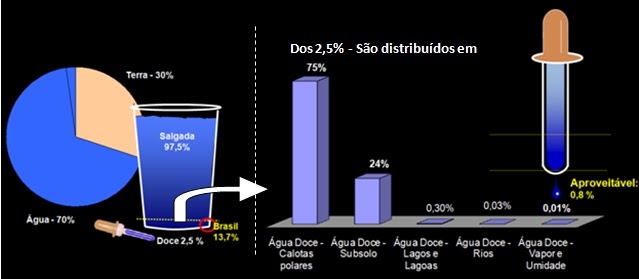
De toda a água disponível 97,5% se encontra nos mares, portanto salgada. A doce é somente 2,5%.
Se colocássemos toda essa água em um copo a doce corresponderia à capacidade de um conta-gotas. Mas não fica somente nisso. Dos 2,5% a grande parte concentra-se nas calotas polares, correspondendo a 75%, portanto não tendo como ser utilizada. No sub-solo temos 24% da água doce, mas também não podemos utilizar indiscriminadamente, pois isso pode provocar problemas, sob o risco de comprometer a sustentação do solo, além de contaminar os lençóis.
Então, a água aproveitável é muito pouca, não chega a 1% da água doce do mundo, o que corresponderia a apenas uma gota do conta-gotas, dentro da analogia que fizemos do copo. E esse 1% compreende as águas dos rios que muitas vezes estão longe dos grandes centros populacionais. Vejam o Rio Amazonas. Toda a sua água não tem como ser utilizada, pois é uma área de baixa densidade demográfica.
A questão da água é preocupante, existindo muitos países que não tem acesso a ela. Pela degradação do solo as nascentes tendem a morrer, pois elas dependem das matas. Mesmo o Brasil que é privilegiado pela quantidade de água existente o assunto requer atenção. Nas regiões ao sul e sudeste, nos períodos de estiagens, já enfrentamos sérios problemas de racionamento e cada vez vai se buscar água em locais mais distantes.
Na região amazônica, pelo processo de desmatamento, a água tende a reduzir, assim como o solo deve ser degradado, pois o solo amazônico é pobre, arenoso. A camada fértil é muito superficial, produto da decomposição de material orgânico gerado pela própria floresta.
Então se você desmata, o solo pode ser utilizado por alguns anos e depois virá areia. Lembremos que o Saara, outrora, foi uma grande floresta tropical.
Questiona-se sobre a possibilidade do aproveitamento de água salgada e realmente é possível. No oriente médio, onde a água é extremamente escassa, existem usinas de dessalinização, mas essa é uma solução muito cara e somente se viabiliza quando forem esgotadas as demais alternativas.
Demanda por energia –
A gula desenfreada
Qualquer atividade humana causa impacto ambiental, porém existem atividades mais danosas que outras.
A sociedade, pelo modelo econômico adotado, necessita cada vez mais de energia e é justamente essa matriz energética a raiz de todos os problemas.
A sociedade necessita de energia crescente. Combustíveis que acarretam todos os problemas de poluição atmosférica, água e solo, assim como a demanda por energia elétrica é igualmente crescente, pois tudo depende de eletricidade.
No Brasil, por exemplo, a energia elétrica é produzida através de hidrelétricas, dada ao potencial hidrográfico existente, embora esses recursos já estejam esgotados. A construção de barragens tem um custo ambiental e social bastante significativo quando de suas implantações. Perderam-se muitas espécies de flora e fauna, quando da construção de Itaipu, por exemplo, além do desaparecimento de cidades que foram submersas.
A geração de eletricidade por meio hidráulico é a mais barata, pois a capacidade de geração é bastante grande, porém depende do índice pluviométrico. Alguns anos atrás nós tivemos problemas sérios com os apagões resultantes da sobrecarga dos sistemas, pois a geração estava no limite de sua capacidade além de estarmos na época em período de grande estiagem, com pouca água nas represas.
No Brasil ainda nós temos a geração de energia, em menor escala, a partir de termelétricas e usinas nucleares. As termelétricas são normalmente movidas a diesel, gerando muita poluição sonora e atmosférica. Cidades no norte, principalmente, são abastecidas por esse meio de geração. Já, as nucleares têm um grande potencial de geração, mas extremamente perigosas. No nosso caso temos duas em Angra dos Reis e a terceira está sofrendo muita resistência dos ambientalistas para ser colocada em funcionamento.
Em outros países, principalmente na Europa, se obtém energia através de usinas nucleares.
Na foto produzida por satélite à noite demonstra como se concentra o consumo de eletricidade. Vemos grandes concentrações de luzes em regiões cuja geografia não dispõe de recursos hídricos suficientes para gerar toda essa energia, sendo realmente produto de termelétricas e fissão nuclear, altamente prejudiciais ao meio ambiente.

Então o grande desafio que se coloca ao mundo desenvolvido são essas questões. Como o homem solucionará essas questões? Como Gerar mais energia, sem impacto ambiental significativo?
Não vejo desfechos felizes para esse modelo de desenvolvimento, mesmo porque o petróleo está se exaurindo e para esta sociedade é dependente desse produto, não só na sua utilização como combustível, como também em aplicações diversas, como na indústria têxtil, petroquímica, eletrônica, haja vista a multiplicidade do uso que se faz de todo material plástico em nossas vidas.
Essa matriz energética levará a disputas acirradas entre nações pela posse das últimas reservas disponíveis, além de criar um custo insustentável para o equilíbrio ecológico.
O desenho do amanhã –
depende de nossa consciência espiritual (o futuro está aberto)
Por outro lado, nós temos que compreender que esse é um processo de grandes transformações que estamos a enfrentar.
A postura humana isolacionista, apartada do todo, está alinhada a uma curva descendente, que são valores alinhados àquela visão mecanicista. No entanto, em contrapartida, vemos que começa a ganhar força novos valores alinhados a outra curva, em ascensão, que está em contraposição, provocando uma ruptura com os velhos padrões. Esta ruptura ao meu ver já iniciou, mas deverá se intensificar nos próximos anos.
A postura humana isolacionista, apartada do todo, está alinhada a uma curva descendente, que são valores alinhados àquela visão mecanicista. No entanto, em contrapartida, vemos que começa a ganhar força novos valores alinhados a outra curva, em ascensão, que está em contraposição, provocando uma ruptura com os velhos padrões. Esta ruptura ao meu ver já iniciou, mas deverá se intensificar nos próximos anos.

Por isso que o presente momento é um tanto que confuso, mas se analisarmos com atenção, nem tudo o que está acontecendo é realmente ruim. Estão sendo desenvolvidos novos dispositivos geradores de energia ambientalmente auto-sustentáveis, que deverão assegurar um melhor padrão de qualidade de vida ao Planeta e a todos nós.
Dependerá de como o homem conduzirá esse processo. Se ele irá adotar uma postura preventiva ou terá que reparar prejuízos provenientes de catástrofes ambientais, talvez com custos de vidas humanas e passivos irrecuperáveis, como é o caso de extinções de espécies, por exemplo.
Como exemplos de fontes renováveis de energia estão surgindo soluções interessantes que deverão ter seu uso ampliado nos próximos anos.
A energia eólica é um exemplo, sendo já utilizada em muitos locais, como na Alemanha, onde são implantados grandes geradores em fazenda, que recebem subsídios.
Existem mais alternativas de energia, como é o caso de placas térmicas instaladas sobre o telhado das casas para o aquecimento de água, a partir da radiação de luz solar. Ainda, a partir da radiação solar, existem as células fotovoltaicas, que produzem eletricidade.
Há ainda a energia produzida pela biomassa, alimentando termelétricas ou mesmo outros motores a combustão. Aqui no Brasil, o álcool anidro já é uma realidade, assim como o biodiesel. Esses combustíveis produzem baixa poluição, embora tenham impactos ambientais no manejo agrícola.
Outro exemplo é o aproveitamento das marés como geradoras de energia. As marés sobem a cada período de 6 horas, sendo que o volume represado quando da cheia é escoado através de dutos, onde são movimentadas turbinas, produzindo-se energia elétrica. Naturalmente a energia produzida é pouca, mas suficiente para abastecer pequenas cidades. O custo ambiental disso é muito pequeno e a fonte é inesgotável.
O próprio hidrogênio está começando a ser usado como combustível, havendo inclusive carros e motos já desenvolvidos e sendo comercializados. A poluição que o hidrogênio emite é inferior a 1% dos combustíveis tradicionais. O grande desafio é a produção do hidrogênio em grande quantidade, mas não é por falta de fonte, pois ele é encontrado na água, no ar, enfim é um combustível renovável e não poluidor.
Então, percebemos que o homem é capaz de criar as condições necessárias para que haja um desenvolvimento sustentável, sem comprometer os meios naturais.
Resta saber, no entanto, se isso não é tardio, pois até quando o planeta resiste à agressão do atual “modelo”?
Se por um lado, esse sistema de vida alicerçado em meios de produção e consumo que degradam o meio ambiente nos coloca em situação de passividade, pois não podemos interferir diretamente no processo, ditado pelos interesses e poder dos grandes agentes econômicos, por outro, podemos e devemos assumir uma postura preservacionista, cientes de que o pouco que possamos fazer, somados a atitudes de igual natureza, poderá representar o diferencial necessário para a salvação ambiental.
Desta forma a transformação é inevitável, sendo urgente que todos nós possamos perceber e compreender a necessidade de engajarmos num processo de mudança de valores, no resgate da importância do ser.
Nenhuma mudança externa, no entanto, ocorre se não for precedida de uma profunda mudança de nossas atitudes internas.
Assim é imperativo transformar o consumo desenfreado em parcimonioso e auto-sustentado, transformar a conquista individual em coletiva e distributiva, substituir a competição egoísta pela cooperação, respeitando-se, naturalmente, as diferenças, os valores e os anseios individuais.
Isto é chamado espiritualidade. É a experiência humana do sagrado e do divino. É a experiência da vida no uno.
Assinar:
Postagens (Atom)